PRPL Technologies

Quiet pickleball paddle technology

All the performance, without the noise.

Paddle makers can now license QYET technology for their own line of quiet paddles.

Less pop noise Sound by pitch. Hard hit, measured at 25 ft.
The pop, close up: hard hit at 25 ft Two measured curves from 900 to 2,400 Hz. One of the leading quiet paddles spikes at about 1,450 Hz, the pop. QYET stays about 14 dB lower there. The pop 1 kHz1.5 kHz2 kHz

14 dB quieterat the pop

One of the leading quiet paddlesQYET

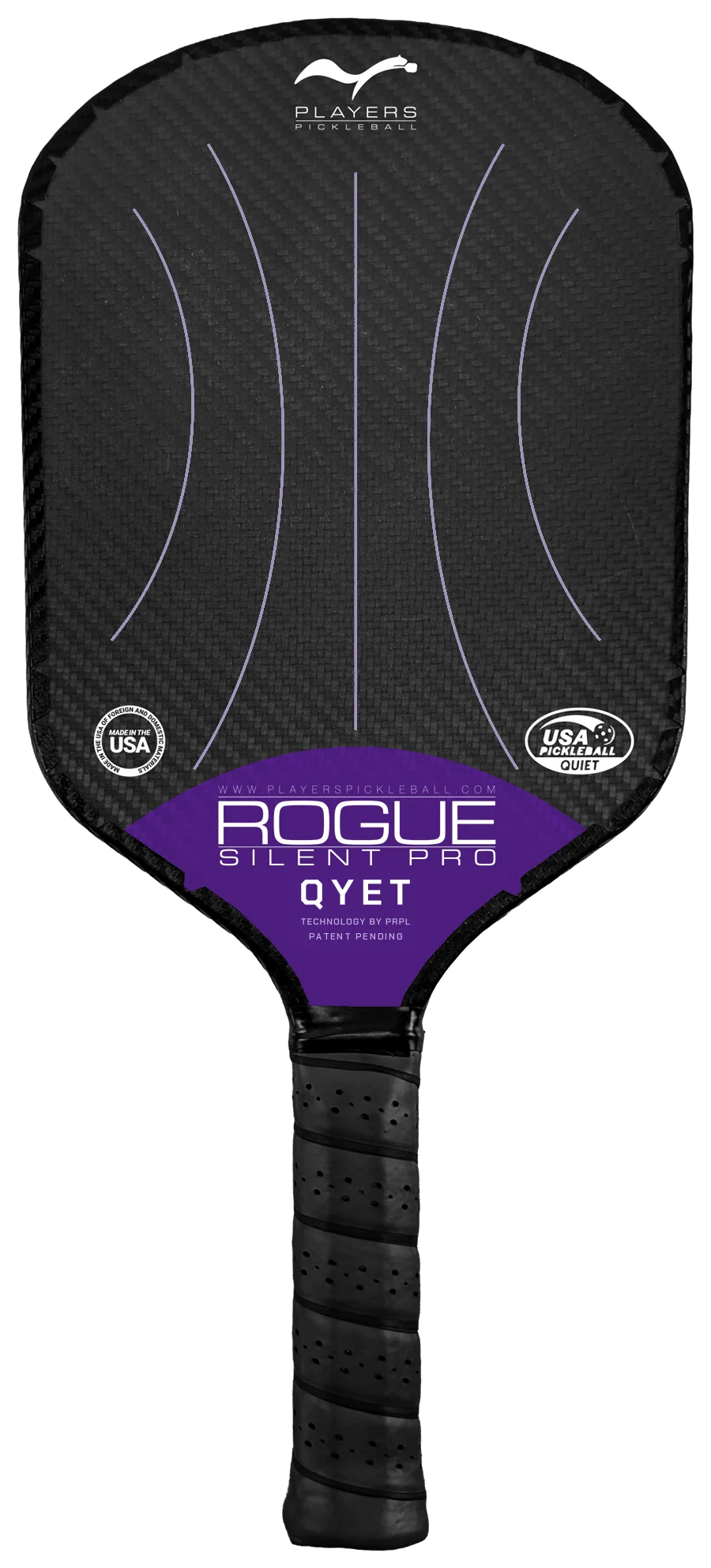
Pickleball paddle built with QYET quiet paddle technology
  • USA PickleballQuiet Category approved
  • Patent pendingQYET technology for pickleball paddles
  • Available to license todayFor pickleball paddle makers

Half as loud at the pop, on every hit we tested

50–62%

quieter to the ear than one of the leading quiet paddles.

That is 10 to 14 dB lower at the pop, on dinks and hard hits.

Test results: peak sound at the pop
Compared with
One of the leading quiet paddles
Pitch range
1,200 to 1,800 Hz
Tested
August 2026
Hard hit, 25 ft
−14 dB
Hard hit, 50 ft
−13 dB
Dink, 25 ft
−14 dB
Dink, 50 ft
−10 dB

Approved for USA Pickleball's Quiet Category

The first paddle built with QYET is approved for the Quiet Category, USA Pickleball's designation for quieter equipment.

See the Quiet Category list ↗

The difference is the pop

Both paddles sound almost the same below about 1,100 Hz. QYET takes out the sharp pop neighbors hear and leaves the rest of the hit.

How we tested →

A 10 dB drop sounds half as loud

The smallest gap we measured was 10 dB, so every test came out at half as loud or quieter.

What that gap means →

Noise complaints are closing pickleball courts

Neighbors hear every hit. Complaints strain relationships, close courts and shrink the places to play.

Quiet pickleball solutions usually come at the cost of play. Paddle covers, soft balls and most quiet paddles cut the sound, but often the performance as well.

The founders of PRPL set out to fix both. QYET technology is the solution.

QYET technology by PRPL

Built into the paddle, from the core out

QYET is a patent-pending quiet pickleball paddle technology built directly into the paddle. Available for licensing today for pickleball paddle manufacturers.

Every layer, material and detail was designed from the core to the playing surface, so a high-performance paddle plays without the noise.

100+
prototypes to get it right
2+
years of development
  • Quiet at every hit level

    Lower peak noise than the leading quiet paddles, on dinks and on hard hits, at 25 and 50 ft.

  • Plays like a high-performance paddle

    Built to match the leading paddles that aren't quiet. Pickleball pro Glen Peterson: “I could convert to this paddle and play a high-level game.”

  • Plays on wet courts

    Quiet paddles with a felt surface struggle, because the felt soaks up water. QYET's quiet is in the core, not on the surface.

“I thought the paddle played amazingly well.”

Glen PetersonPickleball pro

Meet the founders

Overqualified. Overengineered. Over the noise.

Paul Lichon and Dr. Per Reinhall are one rocket scientist and one globally renowned professor. They are avid pickleball players who watched courts shut down over noise and found no quiet paddle that played like a high-performance one. They partnered to found PRPL in Seattle, where pickleball was born.

80+
years of engineering experience
30+
patents between them
Portrait of Paul Lichon

Paul Lichon

Chief Executive Officer

An aerospace engineer who spent 45 years in spacecraft propulsion and defense systems, most recently leading General Dynamics' Seattle operation. The Seattle team delivered space rocket hardware and built the parachute deployment system for NASA's Perseverance Mars rover.

45
years of engineering experience
5
patents
Portrait of Dr. Per Reinhall

Dr. Per Reinhall

Chief Technology Officer

A renowned professor of structural acoustics who taught at the University of Washington and chaired its mechanical engineering department. He launched three startups. One of them, VICIS, made the Zero1 helmet, named one of TIME's 25 Best Inventions of 2017.

40
years of engineering experience
26
patents
170+
research papers

How licensing QYET works

PRPL Technologies is a Seattle company that licenses QYET, patent-pending quiet paddle technology, to pickleball paddle makers. Paddle makers build it into their own paddles, under their own brand.

  1. Tell us about your paddles

    Use the form below to share your brand, your line and what you want from a quiet paddle.

  2. Talk with the founders

    Walk through your line and your goals with Paul and Per.

  3. Build QYET into your line

    Bring QYET's core-out design into your own paddles.

  4. Carry the QYET mark

    Licensed paddles carry the QYET technology by PRPL mark on the throat.

Want to build a paddle with QYET technology?

Tell us about your brand and your paddles to start a licensing conversation with the founders.

Common questions about QYET

What is QYET?

QYET is a patent-pending quiet pickleball paddle technology from PRPL Technologies. It is built directly into the paddle, from the core to the playing surface, and licensed to pickleball paddle makers.

How much quieter is a QYET paddle?

In head-to-head tests it was 10 to 14 dB lower at the pop than one of the leading quiet paddles, on dinks and hard hits. That is heard as about half as loud.

Is QYET approved by USA Pickleball?

Yes. The first paddle built with QYET is approved for USA Pickleball's Quiet Category.

Does a QYET paddle play differently?

It is built to play like a high-performance paddle. Pickleball pro Glen Peterson said he could convert to it and play a high-level game.

What makes QYET different from other quiet paddles?

Most quiet options add something to the paddle or change the ball: a paddle cover, a soft ball or a felt surface. They cut the sound, but often the performance as well. QYET is designed into the paddle itself, so a high-performance paddle plays without the noise.

Why is pickleball so loud?

A hard paddle face strikes a hard, hollow plastic ball, and the contact makes a short, sharp pop that carries well beyond the court. That pop sits between 1,200 and 1,800 Hz, and it is the sound QYET reduces. See what the difference means.

Who created QYET?

Paul Lichon and Dr. Per Reinhall, the founders of PRPL Technologies. Paul is an aerospace engineer and Per is a professor of structural acoustics. Together they have 80+ years of engineering experience and 30+ patents.

Where can I buy a paddle with QYET?

Players Pickleball builds the first paddle with QYET. Pickleball players can buy it directly from Players Pickleball.

Who can license QYET?

Pickleball paddle makers. Players Pickleball is the first licensee.

Is QYET patented?

QYET is patent pending.

What does a license include, and what does it cost?

We walk each paddle maker through the details directly. Send an inquiry and the founders will set up a conversation.